
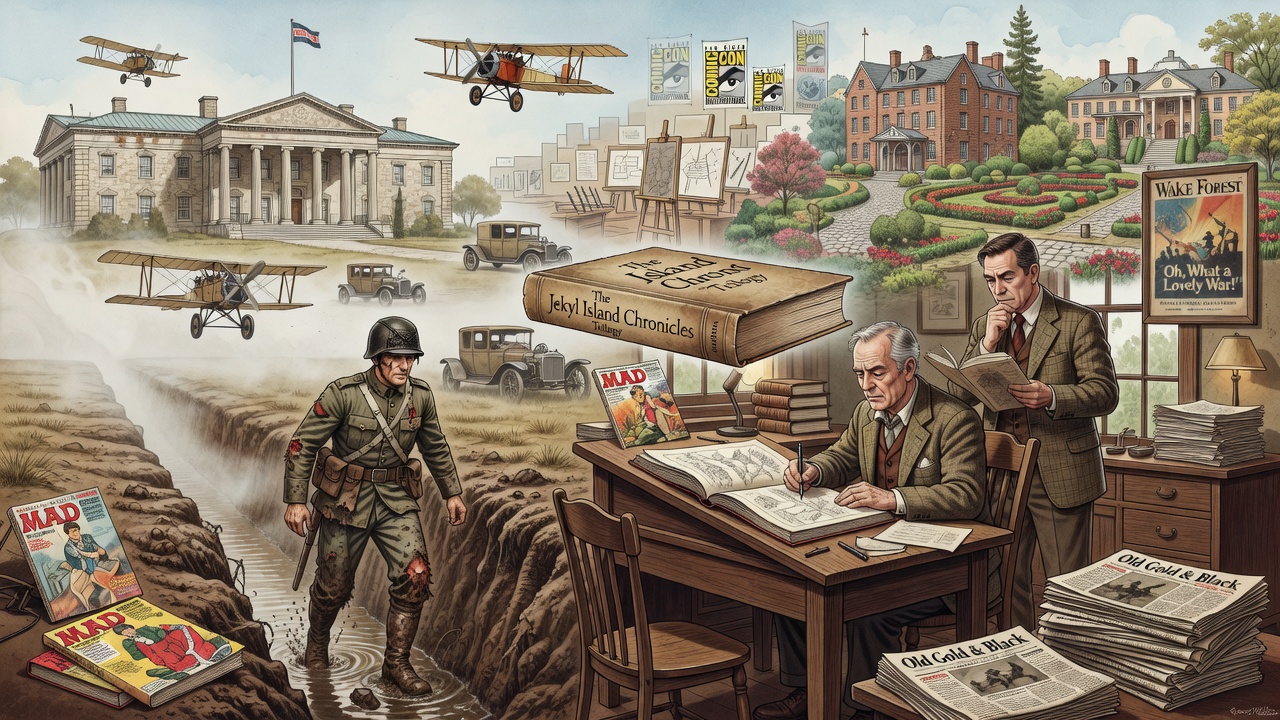
Steve Nedvidek, a longtime cartoonist and former Wake Forest student, has co-created "The Jekyll Island Chronicles," a graphic novel trilogy now collected in a 548-page omnibus. In a conversation with interviewer Vanka, he traced the project from a 1986 university stage production to a 2024 book event at Wake Forest, describing a collaboration built on shared comic book roots and a deliberate effort to revive overlooked history.
From caricature to comic book
Nedvidek says his path began at home, where his father taught him to draw and paint, and in the comics and MAD magazine he read as a child. In high school he drew caricatures of teachers, which he describes as a way to honor their influence rather than mock them. He later wrote and illustrated for the Old Gold & Black, Wake Forest's student newspaper. Those early habits, he suggests, shaped the visual sensibility he later applied to long-form storytelling.
A history class that never happened
The project's starting point, according to Nedvidek, was a spring 1986 Wake Forest production of "Oh, What a Lovely War!", directed by James Dodding, who traveled from London each year to stage work with students. The show, a music hall treatment of World War I, prompted him to ask why the conflict received so little attention in his own schooling. His grandfather, a Bohemian immigrant who enlisted in the U.S. cavalry to qualify for citizenship, served in that war, and the first book opens with an immigrant fighting in the trenches in Belgium. Nedvidek frames the series as an attempt to fill a gap in public memory around a period of rapid technological and social change.
How the trilogy was made
In 2012, Nedvidek and two longtime friends who also grew up reading comics decided to pursue a graphic novel while keeping their day jobs. None of the three had published one before. They sponsored a class at the Savannah College of Art and Design, and its students delivered a pitch packet that became a sales tool. The team hired students as illustrator and colorist and released book one at San Diego Comic-Con in July 2016, with book two following in 2018 and book three completed during the COVID-19 pandemic, largely through digital collaboration. Nedvidek said he laid out roughly 90 percent of the omnibus pages as storyboards, leaving illustrator Prentis Rollins to draw and refine them.
Limits of the story so far
Nedvidek hopes the books may eventually reach television, film or animation, but no such deal is described in the interview, and any adaptation remains speculative. The creators' stated goal is more modest: to give readers, including younger family members, a way into a period they feel is neglected, and to connect readers to local places. Book three includes Winston-Salem landmarks such as Old Salem and Reynolda House, along with Wake Forest figures, which Nedvidek presents as a way of encouraging people to notice the history near them. Whether the trilogy achieves wider cultural recognition is an open question that the available reporting does not settle.