
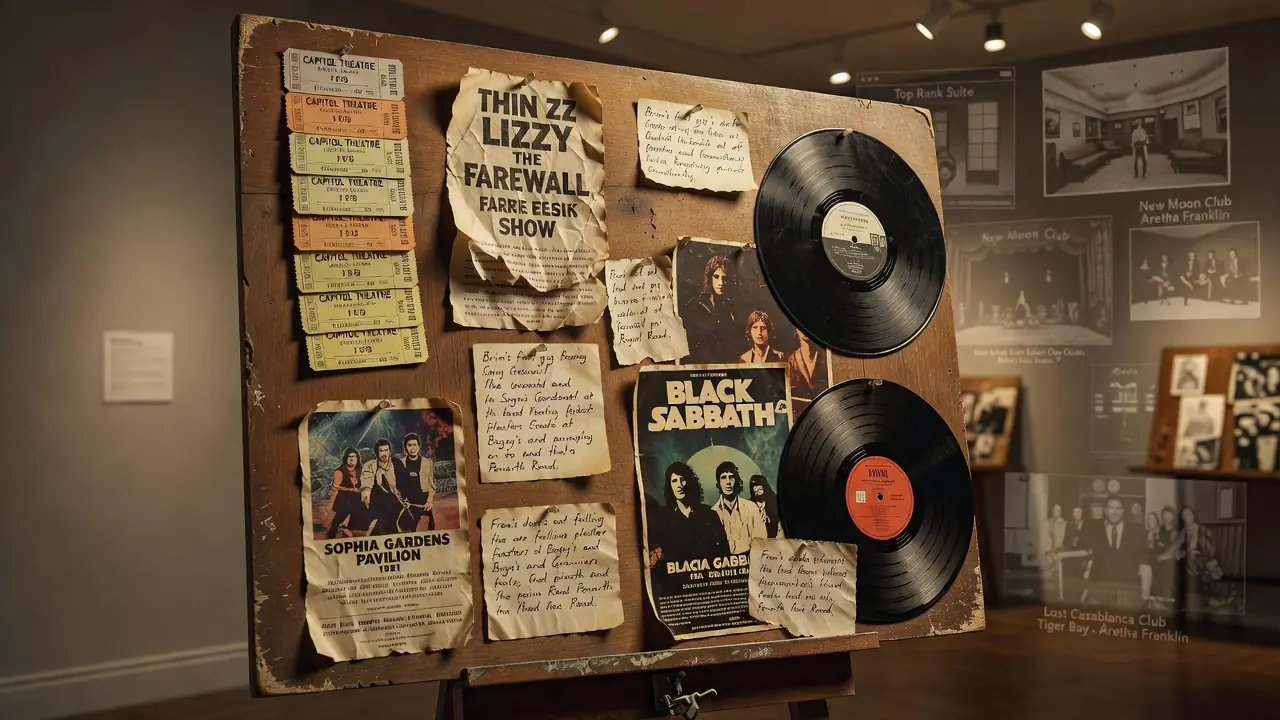
Cardiff Music History's Resonant Places exhibition, staged at the Pierhead Building during the Cardiff Music City Festival, used memorabilia and firsthand fan testimony to bring back the city's vanished music venues. Its curator, David Taylor, focused on what those spaces meant to audiences rather than only to the performers who played them.
Audiences at the centre of the story
Most arguments for saving music venues stress their importance to musicians, but Resonant Places turned attention to the people who paid to get in. Displayed in the Futures Gallery from early September until the second week of November, the show combined ticket stubs, flyers and photographs with a wall of screenprinted posters by Dave Daggers, the artist who remained a familiar figure in the city's art scene until his death late last year.
The most affecting material came from the recollections of fans. Ada described hanging her boots in the trees on Queen Street after they were banned from the Top Rank Suite, and Nik recalled trading a loaf and a trim with the head doorman for entry. Such anecdotes conveyed the sounds and smells of these rooms, from the Newcastle Brown Ale that fuelled the scene to the produce stench that reached the New Moon Club from the nearby outdoor market.
From the Capitol to the grittier rooms
The Capitol Theatre was the most storied venue featured, having hosted the final date of the Beatles' last UK tour in 1965. Visitors also heard how Mike sneaked in with a homemade ticket to Thin Lizzy's farewell show 12 years later, and how Dave camped outside overnight to secure good seats. A 1981 Black Sabbath show at the Sophia Gardens Pavilion was so oversold that the band agreed to play twice.
The exhibition also honoured smaller and rougher spaces that rarely feature in histories of popular music, including Smiley's, Bogey's (later Bogiez) on Penarth Road, and the punk venue Grannies on Queen Street. Fran joked that plaster or sweat falling into her pint was "probably improving the beer in both cases," while Brim, then 14 and at his first gig, was briefly knocked out by a falling ceiling tile during The Clash's set at Sophia Gardens Pavilion.
Preserving memory and the live scene
The exhibition's approach echoes the archival work of Scott Satterwhite and Valerie George's 309 Punk Project in Pensacola, based on the principle that cultural memory must be kept even when buildings are lost. Taylor told Buzz that the aim was to tell "people's stories and where possible" the history of Cardiff through its music scenes. In that light, the Black-owned Casablanca Club in Tiger Bay stands out as perhaps the city's most significant loss, having hosted Aretha Franklin, Jimmy Ruffin and Geraint Jarman among others.
A warning for the present
For this writer, the show was as much a warning as a celebration. With the Moon and Gwdihw lost in the last decade, the exhibition underlined the need to protect current venues with the same energy given to the past. Ben Woolhead's view is that Cardiff Council should commit more resources to supporting the current music scene so that existing rooms do not become mere memories.